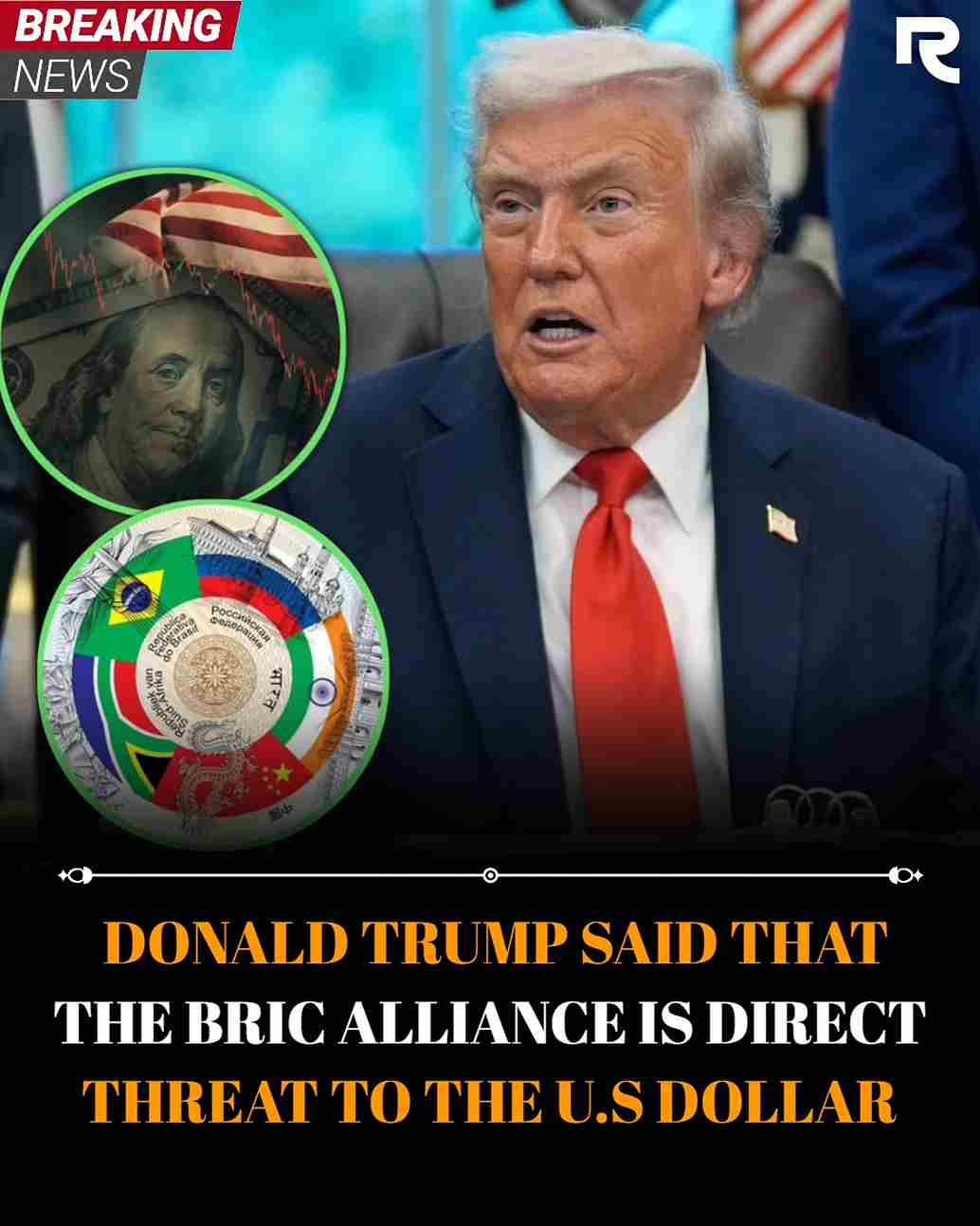
Former President Donald Trump recently stated that the BRICS alliance—a coalition currently made up of Brazil, Russia, India, China, South Africa, and several newly admitted member nations—represents a direct threat to the U.S. dollar’s global dominance. His comments add momentum to an already growing debate over the future of global reserve currencies, international trade practices, and whether emerging economies are successfully building an alternative financial system that rivals long-standing Western institutions.
This topic has drawn significant attention from economists, policymakers, investors, and the general public. Below is a neutral examination of Trump’s remarks, the structure and ambitions of the BRICS bloc, and what this development could mean for the United States and the global economy.
What Trump Said About BRICS and the Dollar
In his recent statement, Trump argued that the expanding BRICS coalition is working collectively to reduce reliance on the U.S. dollar in international trade. He described this trend as a serious challenge to American financial leadership and warned that the weakening of the dollar’s influence could have long-term geopolitical consequences.
While Trump’s language was urgent, his remarks align with ongoing discussions among economists who have monitored BRICS’ efforts to create alternatives to Western-dominated financial networks, including the U.S. dollar, SWIFT banking system, and international lending structures.
Trump emphasized that the United States must protect the dollar’s status as the world’s reserve currency, warning that losing this position could result in economic vulnerability, rising borrowing costs, and diminished global leverage.
Understanding the BRICS Alliance
BRICS was originally formed as a collaborative group among fast-growing economies with the aim of increasing economic cooperation and strengthening collective bargaining power. Over time, the group has evolved into a more ambitious player in global finance and geopolitics.
Core Objectives of BRICS:
- Enhancing trade among member nations
- Reducing reliance on Western banking systems
- Creating alternative financial institutions
- Strengthening regional development projects
- Encouraging use of local currencies in cross-border transactions
Recently, BRICS members have actively discussed creating:
- A shared digital currency for trade
- Increased use of local currencies instead of the U.S. dollar
- New development banks to challenge the World Bank and IMF
These efforts have gained attention because several major global oil producers and emerging economies have expressed interest in joining or partnering with BRICS. This expansion has increased the alliance’s global influence.
Why Some See BRICS as a Challenge to the Dollar
The U.S. dollar has been the world’s primary reserve currency since the mid-20th century. Many nations store their wealth in dollars, and global commodities such as oil are typically priced and traded using U.S. currency.
A shift away from dollar-based trade could:
- Reduce global demand for U.S. Treasury bonds
- Limit America’s ability to impose financial sanctions
- Change how global markets respond to U.S. monetary policy
- Encourage rival financial systems to grow
These concerns have led many analysts to track BRICS developments closely, especially as the bloc expands and explores new trade structures.
Arguments Supporting Trump’s Warning
1. Expanding Membership
BRICS has grown beyond its original five members. The inclusion or interest of major oil-exporting nations gives the group more leverage in global markets.
2. Growing Trade in Local Currencies
Several BRICS members have already signed bilateral agreements to conduct trade in their own currencies rather than using the U.S. dollar.
3. Alternative Financial Institutions
The BRICS-backed New Development Bank offers loans without the political conditions often seen in Western institutions. This creates an alternative pathway for developing countries.
4. Geopolitical Coordination
Some observers argue that increasing cooperation among BRICS nations reflects a collective effort to shift global power balances.
Arguments That BRICS Is Not an Immediate Threat
1. Internal Differences
BRICS includes countries with competing political systems, economic interests, and regional priorities. Internal disagreements often slow progress.
2. Dominance of the Dollar in Global Markets
The dollar is still used in the majority of global transactions. Replacing a long-established currency system is extremely difficult.
3. Economic Strength of the U.S.
The United States retains one of the world’s strongest economies, a trusted treasury system, and political stability relative to many emerging nations.
4. Infrastructure Limitations
Any alternative financial network needs extensive global infrastructure, which takes time to build and maintain.
What This Means for the U.S.
Trump’s comments reflect broader concerns shared by both U.S. political parties and financial analysts. Potential impacts include:
- Trade Adjustments: The U.S. may need to negotiate new agreements to strengthen dollar usage.
- Economic Strategy Shifts: Policymakers may focus more heavily on protecting dollar dominance.
- Diplomatic Repositioning: The U.S. may engage more proactively with developing nations to prevent further BRICS expansion.
Regardless of political perspective, the issue has become a major component of discussions about future U.S. economic policy.
What This Means for the Global Economy
A continued push by BRICS to reduce reliance on the dollar could:
- Encourage regional currency blocs
- Increase the use of digital or alternative settlement systems
- Create a more multipolar financial landscape
- Influence commodity pricing structures
However, such transitions take years—if not decades—to unfold.
Conclusion
Donald Trump’s statement that the BRICS alliance represents a direct threat to the U.S. dollar highlights a growing debate about global currency stability and economic influence. While BRICS is expanding and actively exploring ways to reduce dependence on Western financial systems, the U.S. dollar remains deeply entrenched in global markets.
The full implications of BRICS efforts will continue to unfold over time. For now, the development marks a significant moment in geopolitical and economic discussions, drawing scrutiny from policymakers, economists, and global observers alike.